
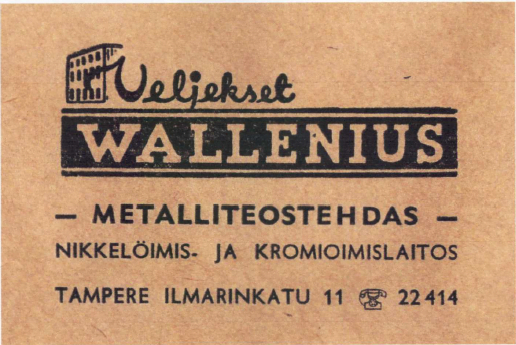
My father, Tuomo Wallenius, worked as a young boy in a business owned by Lauri Grahn. When Grahn decided to give up the business, he offered it to my father, who at the time was only 15 years old. My father’s father, Kalle, guaranteed the loan, but since my father was too young, his 19-year-old brother Olavi agreed to join the company. Olavi was then working as an engraver in a goldsmith’s shop.
The purchase was completed on May 9, 1928. When the brothers applied for a business license at the city magistrate’s office, the mayor looked at them amused and remarked, “Well then, so the boys are planning to become industrialists.” Thus began Leima-, Kaiverrus- ja Niklausliike Veljekset Wallenius (Stamping, Engraving and Nickel-Plating Company, Brothers Wallenius). Stamp manufacturing became the most important product when my father developed a new technique for producing rubber stamps. Their customers included many large factories in Tampere and elsewhere in Finland, such as Suomen Gummitehdas Oy, SOK’s Viipuri mill, the wheat mills of Turku and Hämeenlinna, the Siuro rolling mill, Sortavala Cooperative, Karhula Glassworks, Tammer, Suomen Sokeri, and others. Stamps were also made for Valio, and the Penguin trademark was my father’s own idea.
My father believed that the company’s credibility would suffer if it became known that the manager was so young. Therefore, when customers came to negotiate work assignments, the manager just happened to be “away,” and the assistant handled the matter instead. At that time boys still wore knee-length trousers, but my father was provided with long trousers so he would look older.
The business was first located on the ground floor of Ruuskanen’s building at Koskikatu 7. It later moved to the corner of Pikilinna in Tammela, and then to a two-story building next to Pikilinna at Ilmarinkatu 11. In addition to nickel plating and copper plating, other electroplating processes were carried out, such as brass plating and cadmium plating, and eventually chrome plating was added. Nickel-plated copper coffee pots became fashionable. Other plated products ranged from small washers and fittings to car bumpers. In the grinding shop, items were ground and polished to a high finish.
Before the Second World War, my father traveled to Germany to learn about chrome plating at the Leipzig Trade Fair and at the Langbein-Pfanhauser-Werke factory. The factory director enthusiastically demonstrated the new invention of hard chrome plating by scratching the glass windows of the factory doors with a hard chrome-plated metal rod. Hard chrome plating was introduced at Veljekset Wallenius much later.
During the war, the company worked as a subcontractor for the defense industry, producing items such as folding skis for the German army. My father was also interested in photography and designed equipment for photographers, including a tripod that could easily be attached to the edge of a table or even a tree and adjusted to the desired angle. Studio tripods and light reflectors were also produced. He also designed a pressing stand for tailors.
In the 1950s, in addition to surface treatment, the company manufactured tubular furniture for homes and offices, such as chairs, stools, tables, coat racks, and ashtrays. Store fixtures were also produced, including clothing racks and paper roll holders, for example for Sara Hildén’s clothing store, known as Taivaanlinna, in Tampere. The company participated in trade fairs and advertised in newspapers. Some special projects from that era remain vivid in my memory: music stands were made for the Tampere City Orchestra, organ pipes were chrome-plated for the Kangasala Organ Factory, and locomotive numbers were chrome-plated for Lokomo. Brass protective rails were made around the pillars in the corridors of Tampere Central Hospital. The challenge was that the pillars only appeared identical; in reality, their dimensions differed. My father solved this by creating a measuring aid, carefully extending and numbering each rail. The work was ultimately successful, as the rails are still in place today.
Hard chrome plating became part of operations in the 1950s. Paper machine rolls were repair-chrome-plated, as were wallpaper rolls for companies such as Toijalan Tapettitehdas. The factory premises were becoming cramped and impractical because the plating baths and grinding shop were located on the second floor, making it very difficult to haul heavy items. The brothers began planning a new factory building on a reserved plot in the Sammonkatu industrial area.
Brother Olavi died of a heart attack in 1958, just after turning 50. Shortly before this, important negotiations had been held regarding furnishing new stores for the Ajanmies and Ajatar clothing chains. The orders were received and later delivered. The company was a general partnership, and operations were frozen while assets were settled, and the business was temporarily closed. The unfinished new factory and our apartment in the Kaleva tower building were given up, but after various difficulties, the company was restarted. The business name became Veljekset Wallenius, owned by Tuomo J. Wallenius. It was not worth abandoning the old, well-known name, as it carried a strong reputation.
Olavi had focused more on the commercial side, while my father handled the technical aspects. In addition, sisters Lempi and Aino worked in the office and customer service. Their sister Lahja, a teacher who had studied at a business college, handled the financial statements. I remember one proud moment from that time: our company’s own errand boy, Juho Siiki, carried the Olympic torch for a short distance during the 1952 Helsinki Olympics, and we cheered from the roadside.
After giving up the factory under construction, my father searched for suitable premises elsewhere. One factory near the railway station in Lempäälä and another in Kangasala were considered. However, when wholesaler Orvo Lehtiö purchased the former Hionta Oy factory property at Suoniemi station, he offered it for rent. A rag-tearing facility already operated at one end of the building. The property suited our needs well: previously, products had been shipped by rail across the country, and now the station would be right next door. A major relocation began in the spring of 1962, and by summer all machines had been dismantled and transported by truck to Suoniemi during the thaw season. The Otamus Bridge in Salmi was still low and the road through Pakkala village was soft and muddy, but the move was completed without major incidents.
My father had carefully planned in advance where each bath and machine would be placed. Space was limited, but now everything was at ground level and on a single floor. Not all former employees were willing to commute by train from Tampere. Although trains ran conveniently and some employees did commute for a while, they eventually found work elsewhere. New employees were hired locally. When the rag-tearing operation ceased, the entire building came into our use. The property was purchased outright in early 1968.
In the 1960s, my father became interested in designing a packaging table with holders for paper and twine. It was presented at trade fairs and attracted interest, but plastic bags became widespread in stores and his enthusiasm faded. My father held patents for earlier inventions, and patents were also sought for the paper and twine cutters. Freestanding coat racks and store fixtures continued to be manufactured in Suoniemi. Hard chrome plating became an increasingly important part of the business as the use of hydraulics in machinery grew, increasing demand for hard chrome plating of piston rods. Customers were acquired from many machine shops.
In the late 1960s, artist Kimmo Kaivanto turned to his uncle when designing metal constructions such as “Meridiiani” (Kiasma, Helsinki), “Construction for Wind and Light” (Sara Hildén Art Museum, Tampere), and “Vapaapäivä” (Kiasma). These were manufactured in Suoniemi, as was “Ode to 60,000 Lakes”, a stainless steel sculpture designed in 1973 for the front of Hotel Hesperia in Helsinki. Kaivanto also designed the newer Veljekset Wallenius logo; the earlier one had been created by my father. A more modern pedestal ashtray with a lid was also designed by Kaivanto.
The old chrome-plating equipment became too small, and in the early 1970s plans were made for larger facilities. The old nickel shop was removed and space reorganized. Additional height was needed, so a pit was excavated in the floor and cast as a concrete basin to house new chrome tanks nearly seven meters long. The intermediate floor above the tanks was removed to make room for cranes. This allowed entire steel beams to be chrome-plated, with greater capacity per batch. The rectifier was now powerful enough, and the ventilation system effective.
As VR began reducing train services, transportation shifted increasingly to road transport. The station was closed, and eventually trains stopped at Suoniemi altogether. For a short time, goods were transported via the Siuro and Karkku stations, but that too came to an end.
My father’s health began to decline, and he underwent bypass surgery in 1972. He continued working in the company until 1984, when five employees purchased the business. The company continues operations today as Veljekset Wallenius Oy.
Recounted and compiled by Pirkko Paavola, daughter of founder Tuomo Wallenius.